Is Private Parking Safer Overnight?
Leave a car on a city street overnight often enough and you start noticing the small risks you ignore in daylight. Poor lighting, passing foot traffic, wing mirror damage, opportunistic theft, parking disputes, and the simple fact that no one is really watching it. That is why so many drivers ask the same question: is private parking safer overnight?
In most cases, yes – but only when the space is genuinely private, well managed, and suited to the vehicle and location. A private bay is not automatically secure just because it is off the road. The detail matters. Access control matters. Visibility matters. The surrounding area matters. If you are paying monthly for overnight parking, you want a space that reduces risk in practical terms, not just one that sounds better on paper.
Is private parking safer overnight than street parking?
Compared with street parking, private parking usually gives you a better level of control. That is the real advantage. On-street spaces are exposed to random traffic, limited oversight, and a higher chance of accidental damage or unwanted attention. A private bay narrows the number of people who can get near your vehicle, which is often the first step in making it safer.
For overnight parking, that difference becomes more obvious. Streets are quieter, fewer people are around to notice an issue, and a vehicle left in the same public spot night after night can become predictable. Predictability is useful for a commuter, but it can also be useful for anyone looking for an easy target.
A private space inside a residential development, behind a gate, beneath an occupied building, or within a managed courtyard usually lowers that exposure. It does not make the vehicle untouchable, but it can make access more difficult and less appealing.
What actually makes a private bay safer overnight?
The phrase “private parking” covers a wide range of spaces. Some are excellent for overnight storage. Others are simply off-street and nothing more. If you are comparing options, the useful question is not whether a bay is private. It is how private, how visible, and how controlled it is.
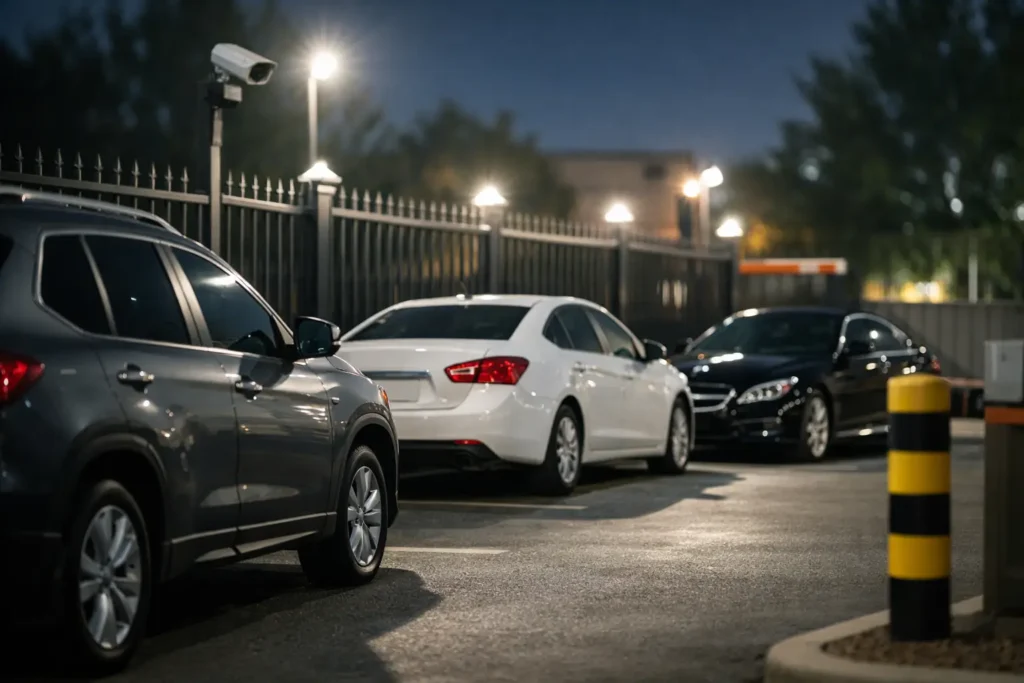
A good overnight space tends to have restricted access, either through gates, fobs, shutters, keypads, or a location that is naturally limited to residents and authorised users. That does not guarantee safety, but it cuts down casual entry. A bay that sits behind a secure entrance in a building used by residents every evening is a very different prospect from an open forecourt anyone can walk into.
Lighting also matters, although there is a balance. A completely hidden bay can feel secure, but poor visibility can work against you if no one would notice suspicious behaviour. The better setups are visible enough to discourage interference, while still being away from busy public footfall.
Passive oversight is one of the most underrated factors. If a space is overlooked by occupied flats, concierge staff, residents, or regular building users, there is a stronger chance that unusual activity gets noticed. Overnight security is not only about barriers. It is about whether the setting makes unwanted behaviour harder to carry out unnoticed.
Surface condition and layout matter too. Tight, awkward bays in underground areas can reduce street exposure but increase the risk of scrapes, poor manoeuvring, or neighbouring vehicle damage. For owners of higher-value, prestige or classic vehicles, physical security is only part of the equation. You also want a space that is easy to access cleanly and consistently.
When private parking is not necessarily safer overnight
There are cases where a private space is not clearly better. An open residential bay with no gate, no cameras, no lighting and no nearby oversight may still be vulnerable. In some locations, a vehicle parked in a quiet but unmanaged private area can be less visible in the wrong way.
That is why blanket claims do not help. If a bay is tucked behind a building but accessible from the pavement, poorly lit, and rarely used, it may offer less reassurance than a well-lit public street outside occupied homes. Privacy alone is not protection.
You should also be realistic about shared developments. A space can be technically private while still seeing regular access from delivery drivers, visitors, contractors, and other residents. If keys, fobs or codes are widely circulated, the security benefit becomes weaker.
For overnight parking, the best private spaces are those with clear ownership, controlled entry and limited churn. A bay used by one regular driver in a stable building is generally more predictable and easier to trust than one in a loosely managed development with constant movement.
Who benefits most from safer overnight private parking?
Some drivers feel the difference immediately. If you live in a city-centre flat without allocated parking, overnight street parking can become a constant low-level hassle. You may be checking the car before bed, moving it around restrictions, or worrying about where you left it after a late return. A dependable private bay removes that friction.
Commuters who leave a vehicle overnight several times a week also benefit. So do owners of newer, prestige, performance or collector vehicles who are not prepared to leave them exposed on public roads. In those cases, overnight parking is not just about convenience. It is about preserving condition, reducing avoidable risk, and keeping access predictable.
This is particularly relevant in dense areas of Manchester and Salford where space is limited and kerbside demand stays high. A private bay in Deansgate, Castlefield, Spinningfields or Salford Quays is not simply a nicer option. For many drivers, it is the practical answer to a parking environment that becomes less reliable after dark.
How to judge whether a private space is worth paying for
If you are choosing a monthly space, ask practical questions rather than relying on labels. Is the bay gated or open? Who else can enter? Is it overlooked by residents or staff? Is it well lit? Is there any sign of regular misuse, abandoned vehicles, or poor management? How easy is it to access late at night without waiting around outside?
You should also think about your own routine. A bay that is very secure but awkward to reach may become frustrating if you use the car daily. The safest option is not always the one with the most barriers. It is the one that gives you consistent access while keeping unnecessary exposure low.
For drivers storing a valuable vehicle overnight, the ideal setup is usually simple: off-street, restricted access, low public visibility, sensible lighting, and a building or location with regular legitimate activity. That is often more useful than flashy security claims.
This is where a curated private parking arrangement has an advantage over generic listings. When spaces are matched properly, the details are clearer from the outset – what type of bay it is, how access works, whether it suits regular use, and whether it genuinely fits overnight parking rather than occasional daytime parking.
Is private parking safer overnight for valuable cars?
Usually, yes, and the more distinctive or desirable the vehicle, the more that matters. A high-value car left on the street overnight draws attention for all the wrong reasons. Even if theft is not the issue, cosmetic damage, tampering, and accidental knocks become more likely over time.
Private parking lowers visibility and reduces random interaction. That alone makes it attractive for owners who care about vehicle condition. But again, the quality of the space matters. A secure underground bay with controlled access is one thing. An open side yard with no oversight is another.
For valuable cars, overnight safety is really about reducing variables. Fewer unknowns, fewer passers-by, fewer opportunities for damage. A good private bay helps because it creates a more controlled environment.
The trade-off: safety versus convenience
There is always a balance. The safest-feeling space may be slightly less convenient. The easiest-access bay may be a little more exposed. Most drivers are not choosing between perfect and poor. They are choosing between realistic options.
That is why the best decision usually comes from matching the bay to the driver. If you need fast daily access for work, you want security that does not slow you down. If the vehicle is used only occasionally, you may accept a more controlled setup with less immediate access. If your priority is pure overnight peace of mind, then restricted entry and low exposure should come first.
For many city drivers, the question is not whether private parking eliminates every risk. It does not. The real question is whether it gives you a materially better overnight parking situation than leaving the car on the street. In many cases, it does.
Manchester City Parking sees this firsthand with drivers looking for dependable monthly bays rather than short-term stopgaps. The demand is rarely about luxury. It is usually about removing uncertainty.
If you are weighing up overnight parking, trust the specifics over the label. A well-chosen private bay can make a real difference, not because it sounds more secure, but because it gives your vehicle fewer chances to become someone else’s problem.