How to Park Prestige Cars Safely in Manchester
A prestige car can be perfectly at home in Manchester city centre, but only if its parking arrangement is as considered as the vehicle itself. Knowing how to park prestige cars safely is less about finding the closest available space and more about choosing a dependable private setting that protects the car every day, not just when it is in use.
For an owner of a high-value, performance, classic or collectible vehicle, a monthly parking space should provide certainty. That means controlled access, sensible dimensions, clear terms and a route into the bay that does not turn every arrival into a calculation.
Start with the parking environment, not the postcode
A central location is useful, particularly for residents and professionals around Deansgate, Spinningfields, Castlefield, New Jackson and Salford Quays. Yet convenience should not override the fundamentals. A well-managed private bay a few minutes further from your front door can be the better choice if it offers easier access, more room around the vehicle and a consistently secure environment.
Look first at whether the space is genuinely off-street and privately managed. An allocated residential bay, locked garage or secure vehicle storage arrangement gives a clearer level of control than an exposed, transient setting. Ask how entry works, who else can access the area and whether the same access arrangements apply at all times.
The answer will depend on the car and how often you use it. A daily-driven executive saloon may suit a secure underground allocated bay. A low-slung sports car or a cherished classic may be better in a private garage with less passing traffic, more space and fewer opportunities for accidental contact.
Check access before agreeing to a long-term space
The bay itself is only one part of the arrangement. The approach to it matters just as much. A wide, clearly marked bay is of limited value if the entrance ramp is steep, the turning circle is tight or the access road is regularly obstructed.
Before committing, inspect the route in and out in person where possible. Take note of ramp angles, speed humps, sharp turns, low ceilings, pillars and door widths. Vehicles with low ground clearance, a long wheelbase or wide doors need more tolerance than standard family cars. Do not assume that a bay in a premium development will automatically suit every prestige vehicle.
It is also sensible to think about the practical rhythm of use. Can you enter without reversing through a difficult blind corner? Is there enough space to open the driver’s door without risking contact with a wall or neighbouring vehicle? Does the exit allow a clean turn without clipping kerbs or manoeuvring repeatedly? These details become more significant over a twelve-month arrangement.
Measure the space, and allow for real-world use
Published dimensions are helpful, but they do not always show the full picture. Bay markings can be worn, pillars can reduce usable width, and a neighbouring vehicle may sit close to the line. Measure the available width and length if there is any doubt, then allow room for mirrors, doors and comfortable entry.
For wider prestige cars, a space beside a wall or column can be workable only if the layout leaves enough clearance on the driver’s side. For a coupe with long doors, the extra room needed to get in and out can be greater than expected. A garage should be assessed with the door fully opened, not simply from its advertised dimensions.
If the space is beneath a residential building, check the height from the entrance through to the allocated bay. Roof-mounted accessories are not the only issue. Some vehicles have a raised boot line or body shape that makes a close ceiling feel more restrictive than a figure on paper suggests.
Prioritise controlled access and predictable users
Security is not one single feature. It is the combined effect of where a vehicle is kept, how people enter, how many people move through the area and whether the arrangement is properly managed.
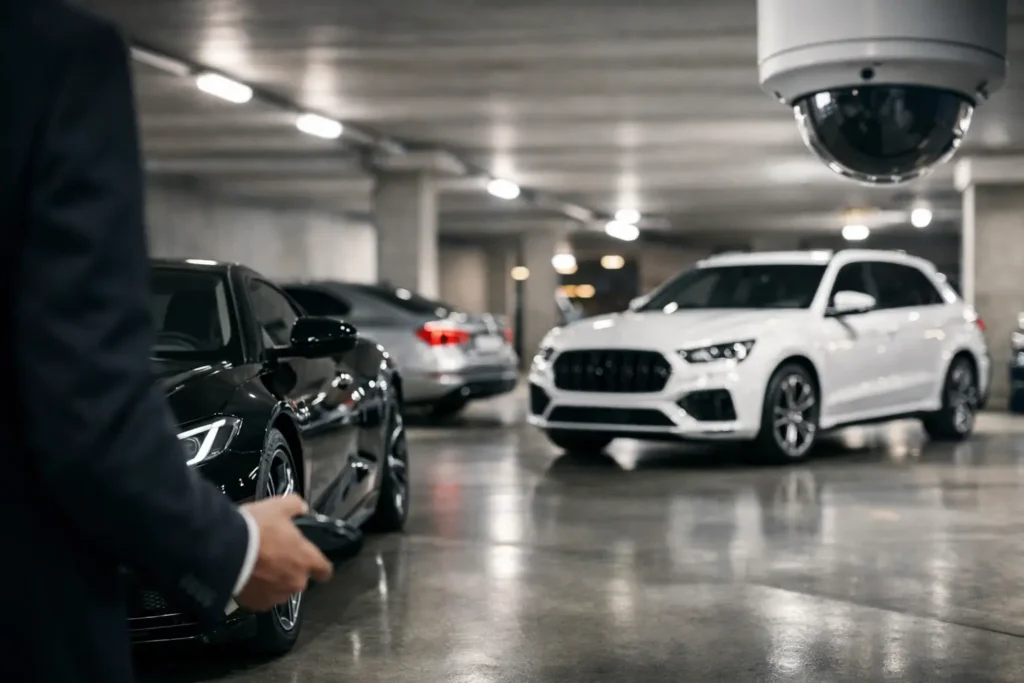
A private development with controlled fob, key or remote access can offer a strong starting point, particularly when access is limited to residents, occupiers and approved users. A locked private garage can add another layer of separation. Lighting, visible cameras and a concierge presence may also provide reassurance, but they should support a sound parking arrangement rather than replace one.
Ask direct questions before renting. Who holds access devices? Can access be cancelled when an agreement ends? Is the bay allocated solely to you? Are there any restrictions on who may use the space? A clear answer protects both the driver and the space owner.
For space owners, careful matching is equally valuable. A long-term driver with a known vehicle, agreed access process and a clear start date is easier to manage than a succession of informal users. Keeping the arrangement simple reduces uncertainty around keys, fobs and day-to-day use.
Protect against avoidable damage inside the bay
Most parking-related damage to prestige cars is not dramatic. It tends to be a door opened too close, a mirror caught on a pillar, a wheel brushing a kerb or a bumper meeting an unseen obstruction. A safe bay reduces these ordinary risks.
Choose a position with clear sight lines and enough room to manoeuvre in one deliberate movement. End bays can be appealing because they may offer additional space on one side, although they can also sit beside a traffic route. A bay beside a lift lobby, bin store entrance or heavily used pedestrian path may experience more passing activity than a quieter allocated position.
If the space has a wall, column or storage area nearby, assess whether it creates a blind spot when parking. The best arrangement is one you can use consistently without relying on luck or last-second corrections. If a car requires awkward manoeuvring every time, it is probably not the right long-term space.
Cleanliness matters too. Persistent standing water, loose debris, leaking pipes or poor drainage can make a bay less suitable for a vehicle that is stored regularly. An indoor space is not automatically better if it is damp or poorly maintained. Check the condition rather than relying on the label.
Consider cover, ventilation and time away from the car
A car parked for several days a week has different needs from one used daily. Covered parking can protect paintwork and interiors from prolonged exposure, while an enclosed garage can provide privacy and a calmer storage environment. However, garages need sensible ventilation and should be dry, clean and secure.
For a classic or collectible car, the right decision may be a dedicated private garage or a suitable secure storage space rather than a standard flat bay. The trade-off is often accessibility. A central underground bay is convenient for regular driving; a more enclosed arrangement may offer better protection when the vehicle is used less often.
Think honestly about your routine. If you travel frequently for work or keep the car off the road for extended periods, choose a space you can inspect easily and return to with confidence. If you use the vehicle most weekdays, a bay with straightforward access is likely to be the priority.
Put the long-term arrangement in writing
A secure location is only part of safe parking. The agreement should be clear enough that both sides know what has been agreed. Confirm the exact bay number or garage, monthly payment date, notice period, authorised vehicle details and access arrangements before the first payment is made.
Take dated photographs of the bay at the start, including markings, walls, gates and any existing condition issues. Drivers should retain details of the access process and know who to contact if an entry device stops working. Space owners should record the fobs, remotes or keys issued and the date they are returned.
It is worth confirming whether there are building-specific rules affecting vehicle size, use of garages, storage around the bay or access hours. These are not minor administrative points. They can determine whether a space remains practical over the full term.
Manchester City Parking helps drivers and space owners make these arrangements around secure, private long-term bays and garages, where clarity matters as much as location. A quick, informed conversation before agreeing a space is usually far easier than correcting a poor fit later.
How to park prestige cars safely over the long term
Once you have selected the right space, consistency does the rest. Park within the markings, leave sensible clearance where the layout allows and avoid treating the bay as a place to store loose items around the vehicle. Keep access devices secure and report any change to the agreed arrangement promptly.
Revisit the suitability of the space if your routine changes. A bay that worked well for occasional use may no longer be ideal when the car becomes a daily driver, or when a second vehicle changes the way neighbouring spaces are used. The most dependable parking solution is one that continues to fit the car, the building and your day-to-day life.
A valuable vehicle deserves more than a convenient address. Choose a private space that you can enter calmly, leave confidently and rely on month after month.