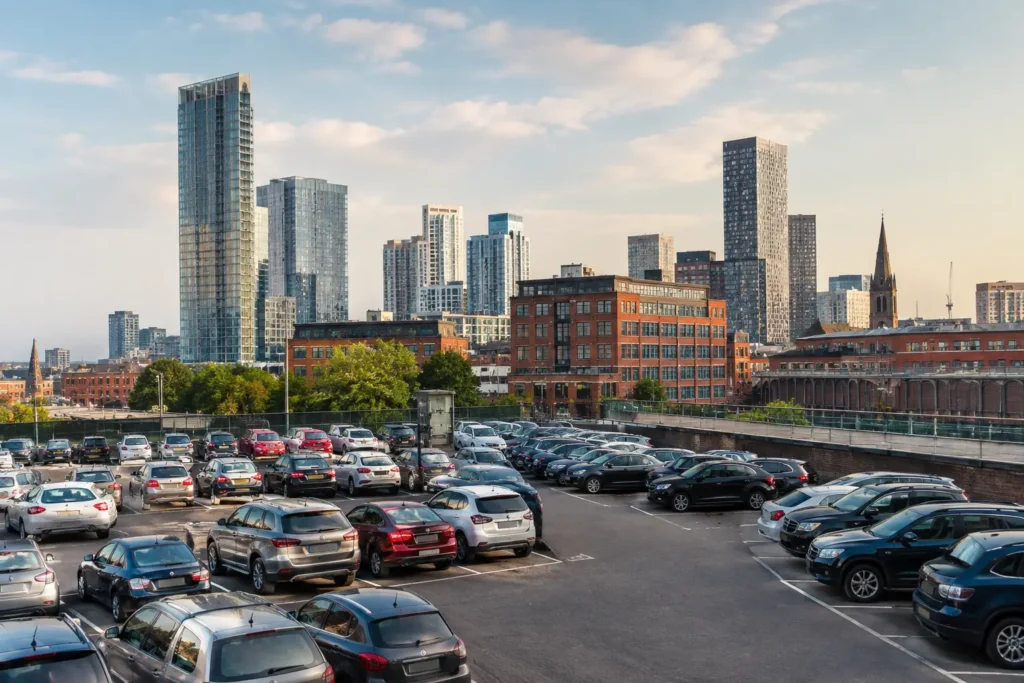
Why Manchester Parking Supply Falls Short
A resident can move into a new city-centre flat with concierge access, secure entrances and a premium finish, then discover that a dependable place for their car is the missing part of the arrangement. That gap explains much of Manchester’s parking supply problem. The issue is not simply the number of marked bays on a map. It is whether a suitable private bay is available, accessible, secure and offered on terms that work for a long-term driver.
For commuters, residents and businesses, the shortage can feel most acute in the places where time matters most: near home, close to work and within well-managed developments. For bay owners, the same shortage creates a practical opportunity. An unused allocated space can be a valuable asset when matched with the right monthly user.
Parking Supply Is More Than a Bay Count
Parking supply is often discussed as though every space is interchangeable. In central Manchester and Salford, it rarely is. A space behind a controlled entrance in a residential development serves a different purpose from an exposed space with limited access, and a standard bay may not suit a wider vehicle, a classic car or a driver who needs predictable access every day.
The supply that matters to long-term users is usable supply. That means the bay is available now or within a reasonable timeframe, the owner has the right to let it, building rules permit the arrangement, and the location suits the driver’s routine. A space may technically exist but add nothing to the active market if it is tied to a lease, retained for occasional visitors or simply unknown to people looking nearby.
This is why a shortage persists even in developments with underground parking. Private bays are fragmented among leaseholders, landlords, owner-occupiers and investors. Some are vacant for months; others are used only intermittently. Without a straightforward route to bring those spaces to market, demand and supply fail to meet.
Why Parking Supply Is Tight in Key Manchester Districts
Manchester’s residential growth has reshaped the demand for monthly parking. Large developments have attracted people who want city-centre living without giving up the flexibility of having a vehicle. Not every flat includes a bay, and not every resident who initially decides against parking remains comfortable without one once work, family commitments or regular travel patterns change.
The pressure is especially noticeable around Deansgate, Spinningfields, Castlefield, New Jackson, Greengate, Ancoats and the Northern Quarter. These are areas where homes, workplaces and leisure destinations sit close together, while private off-street parking is distributed unevenly between buildings.
At Salford Quays and MediaCity, the calculation is slightly different but the result is similar. Professionals and businesses may need reliable weekday access, while residents want the reassurance of returning to a known, managed bay. A driver will often choose a space that is a few minutes further away if it is secure, easy to access and available on a stable monthly basis. Proximity matters, but certainty matters too.
New developments do not automatically solve the problem
It is reasonable to assume that new towers and build-to-rent schemes create enough parking for their residents. In practice, the number of bays may be limited, separately owned or allocated to only some units. A building can therefore have spare spaces while residents are still searching for one.
There is also a timing issue. A new resident may need parking immediately after completion or a tenancy begins, while an owner with an unused bay may not realise there is demand in the same development. The result is a local mismatch, rather than a complete absence of spaces.
What Drivers Should Look for in a Long-Term Space
When monthly parking is hard to find, taking the first available offer can create avoidable problems. The right space depends on the vehicle, the driver’s routine and the level of security required. A business user may prioritise access before and after standard working hours. A resident may value a bay within their own building or a nearby secure development. An owner of a prestige or collectible vehicle may place vehicle protection above walking distance.
Before committing, drivers should establish the basics: whether the bay is allocated and properly authorised for rental, how access is provided, whether the entrance and bay dimensions suit the vehicle, and what notice arrangements apply. It is also sensible to understand who is responsible for access devices, building rules and any lost fobs or permits.
A clear direct arrangement prevents the common uncertainty of informal parking. The monthly cost should be agreed upfront, along with the start date and practical handover process. For a long-term user, the value lies in avoiding repeated searches and knowing the same space will be available each day.
Security is practical, not just a selling point
For valuable cars, a secure setting is not an optional extra. Controlled access, enclosed garages, monitored entrances, good lighting and a professionally managed environment can all influence suitability. However, drivers should avoid assuming that the word “secure” means the same thing everywhere.
Ask what access controls are in place and whether the parking area is shared with residents, businesses or the public. Consider the route into the bay as well as the bay itself. Tight ramps, low clearances and awkward turns can make an otherwise attractive space unsuitable for some vehicles.
The Opportunity for Owners of Unused Bays
An empty residential bay is easy to overlook, particularly if it came with a flat that is rented out or used as an investment. Yet in a high-demand location, it can provide dependable monthly income without changing the use of the property itself.
The strongest listings are specific. State the development or precise local area, whether the bay is covered or underground, the access arrangement, vehicle restrictions and the monthly rent sought. Clear photographs and accurate dimensions help prevent unsuitable enquiries, which is better for the owner and the eventual driver.
Owners should also check their lease, management company requirements and any relevant building rules before offering a space. This is not unnecessary admin. It protects the arrangement and makes it easier to match with a driver who understands the conditions from the outset.
Long-term rentals generally work best when both sides expect a straightforward, respectful arrangement. A resident may want a reliable neighbour using the space rather than a changing stream of unfamiliar vehicles. A driver wants an owner who can respond if access needs to be arranged. Careful matching is more valuable than chasing the highest possible rent for a single month.
Better Matching Can Improve Manchester’s Parking Supply
Building more bays is not the only response to constrained parking supply. Making existing private spaces visible and available can be just as useful, particularly in dense districts where new capacity is difficult to create.
This is where local knowledge matters. A driver looking near Deansgate Square has different requirements from a business seeking employee parking close to Spinningfields, or a landlord with an unused bay at MediaCity. Treating all spaces as generic listings misses the details that determine whether an arrangement will last.
Manchester City Parking focuses on those details by connecting drivers with privately managed bays, garages and secure vehicle storage suited to long-term use. For owners, listing an unused space can turn dormant capacity into income. For drivers, a properly matched private bay replaces uncertainty with a consistent place to park.
A Practical Way Forward for Drivers and Owners
Drivers should begin with the area they genuinely need, rather than casting the net too widely. A space close to home or work, with the correct access and security, is usually worth more than a nominally cheaper option that creates daily inconvenience. Be clear about the vehicle, required start date and whether the space is for residential, commuter or business use.
Owners should look at unused capacity with fresh eyes. If a bay is sitting empty because a tenant does not have a car, an owner works remotely, or a household has fewer vehicles than expected, there may be a nearby long-term user already searching for exactly that space.
The most useful answer to a tight market is not a waiting list. It is a clear, direct match between a suitable private bay and someone who will value it every day.