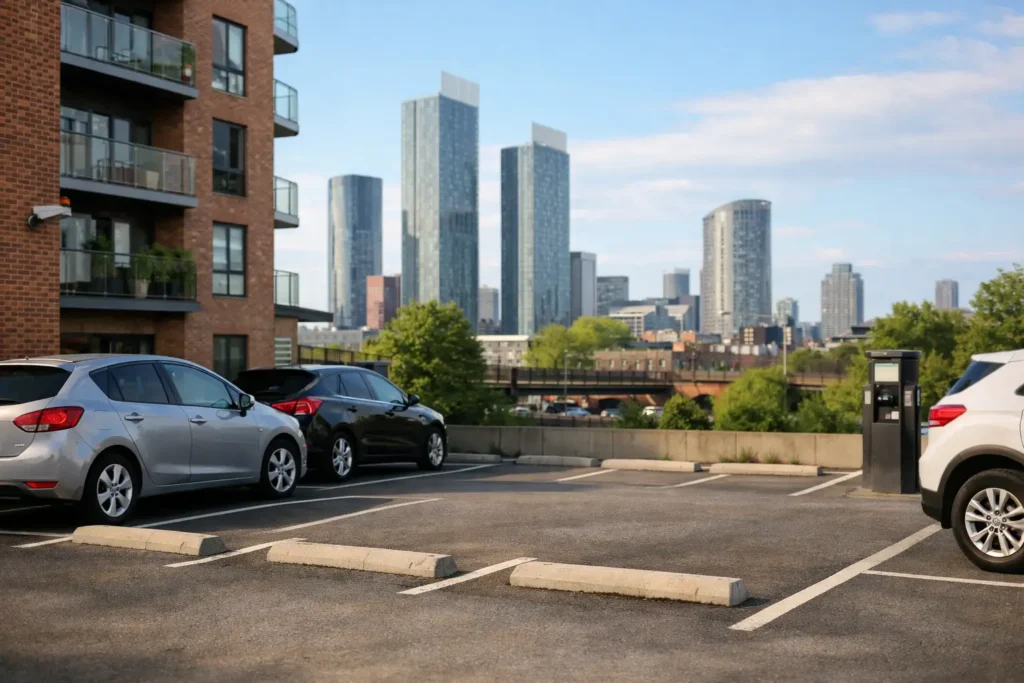
List Unused Apartment Parking in Manchester
An allocated bay sitting empty beneath a residential development can be more than an overlooked convenience. In areas where residents, professionals and businesses compete for secure monthly spaces, choosing to list unused flat parking can turn a fixed property cost into dependable income – without giving up ownership of the space.
For owners in Manchester city centre and Salford, demand is rarely abstract. A driver may need a bay close to their flat at Deansgate Square, a dependable place near their workplace in Spinningfields, or secure storage for a valuable vehicle away from the street. The right arrangement gives them certainty and gives the bay owner a straightforward monthly return.
Is your flat parking bay suitable to rent out?
Most allocated residential bays are suitable for long-term rental, but suitability starts with the paperwork rather than the painted line on the floor. Check your lease, tenancy agreement or title documents to establish whether the bay is included with your property and whether there are restrictions on letting it separately.
Some developments permit owners to rent their spaces freely. Others require written approval from a managing agent, freeholder or concierge team, particularly where access fobs, underground gates or visitor procedures are involved. A restriction does not always mean renting is impossible, but it does mean the arrangement should be agreed properly before a driver is offered the space.
Be clear about what is being rented. Is it a numbered bay in a gated basement, an above-ground allocated space behind a barrier, a lockable garage, or a secure storage space for a vehicle that is used infrequently? The level of security, access and vehicle suitability will shape both demand and realistic monthly pricing.
A space should also be practical. Check the bay number is visible, the route in and out is clear, and the dimensions suit the type of vehicle likely to use it. Tight turns, low ceilings, tandem bays and restricted entry times are not necessarily deal-breakers, but they need to be described accurately from the start.
What makes a private parking listing work
The strongest listing is specific enough to avoid wasted conversations. Drivers looking for long-term parking are not simply comparing locations. They are assessing whether they can reliably access the space before work, return late, leave a vehicle for several days, and trust that their bay will still be available each month.
Start with the exact area and development where appropriate. A bay near New Jackson, Castlefield, Greengate, Ancoats, Salford Quays or MediaCity has a different audience and value proposition. Name nearby business districts or residential landmarks only where they genuinely help a driver judge convenience.
Then explain the access arrangement in plain language. State whether the site has a gated entrance, underground parking, CCTV in communal areas, a staffed concierge, fob or remote entry, or a lockable garage. Do not overstate security. A well-managed private development is attractive, but drivers should understand precisely what is and is not provided.
Good photographs matter because they answer practical questions quickly. Include the entrance, the route into the car park where possible, the bay itself, and any relevant height restriction signage. Avoid showing other residents’ registration plates, personal possessions or building access information that should remain private.
Your listing should also say whether the bay is available immediately, the preferred minimum term, and whether it is suitable for larger vehicles. If access requires an additional fob or remote, explain how that will be issued and what happens when the rental ends.
Set a monthly price with the right context
There is no single rate for flat parking across Manchester. A secure basement bay within walking distance of Deansgate or Spinningfields will usually command more than an open space further from the core, while a private garage may appeal to a different market altogether.
Pricing depends on the development, proximity to homes and workplaces, security, access hours, vehicle size and local supply. A space in a building where many flats were sold without parking can be particularly valuable. Equally, an ambitious price can leave a bay unoccupied when comparable private spaces nearby offer better access or clearer terms.
Treat the monthly amount as part of a complete proposition. Drivers who need reliable parking for work or a valuable vehicle often place real value on consistency, a direct point of contact and secure off-street access. A fair, transparent price is more likely to attract a long-term renter than a rate that needs frequent renegotiation.
Put clear terms around the rental
A private parking arrangement should be simple, but never vague. Before keys, fobs or remotes change hands, confirm the monthly rent, payment date, notice period, start date and exactly which bay is being used. Both parties should have these details in writing.
It is sensible to agree whether a deposit is required for access equipment and how it will be returned once the fob, remote or key is handed back in working order. Keep records of any items issued, including their condition and serial number where relevant.
The agreement should make clear that the driver may use only the allocated space and must follow the development’s reasonable site rules. That may include keeping access routes clear, observing any height limits, and not using the bay for storage beyond the vehicle itself. If the car park has rules about vehicle type, commercial use or overnight access, raise them before the arrangement begins rather than after a complaint.
Owners should also consider the practical boundary between renting a bay and managing a resident’s wider needs. You are providing a parking space, not a concierge service. Setting a reliable contact method and a sensible process for access issues helps keep the arrangement professional and low-maintenance.
Choose the right long-term renter
A carefully matched renter is usually more valuable than the first person to ask. Long-term users tend to want stability: a resident whose flat has no allocated bay, a city-centre professional, or a business arranging employee parking. They are more likely to respect the access process and less likely to create repeated turnover.
Ask enough questions to establish whether the space fits their needs. Confirm the vehicle type and approximate size, intended start date, expected length of stay and how often access is needed. For secure vehicle storage, it is reasonable to discuss whether the vehicle will be moved regularly, especially if the site has any rules that affect prolonged stays.
There is a balance to strike. Owners should not create unnecessary hurdles for a genuine renter, but neither should they hand over a building fob before confirming the terms, payment process and identity of the person using the bay. Clear communication at the outset prevents most avoidable problems.
Manchester City Parking helps owners bring unused private bays, garages and secure spaces to a targeted long-term market, with direct arrangements between owner and driver and no ongoing platform commission. For owners who do not have time to field enquiries from unsuitable renters, a specialist local matching service can make the process more controlled.
Common mistakes when listing an unused bay
The most expensive mistake is assuming that any vacant space can be rented without checking the lease or management rules. The next is writing a listing that is too brief to be useful. “Secure parking in Manchester” does not tell a driver whether the bay suits their vehicle, whether access is available when needed, or how close it is to where they live or work.
Another common issue is failing to plan the handover of access equipment. Building fobs are often controlled by a managing agent and may carry a replacement cost. Agreeing this in advance protects both sides and avoids uncertainty at the end of the rental.
Finally, do not overlook the value of responsiveness. A driver looking for monthly parking may be comparing several options in the same week. A clear answer on availability, location, access and terms can be the difference between a serious long-term arrangement and an empty bay for another month.
An unused flat space does not need complicated marketing or constant management to earn its keep. With permission in place, honest details and a renter whose needs match the bay, it can become one of the simplest assets attached to your property.