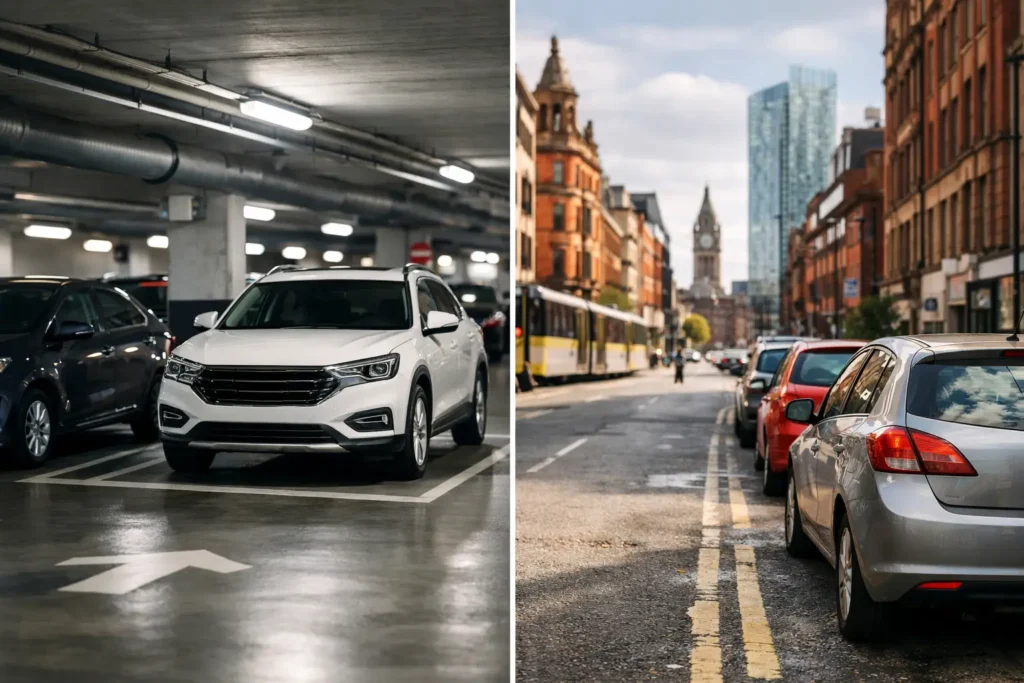
Underground Parking vs Street Parking in Manchester
For a driver who needs a dependable place to leave a vehicle every day, underground parking vs street parking is not simply a question of convenience. It affects how secure the vehicle is, how predictable the routine feels, and whether the parking arrangement genuinely works over months rather than days. In Manchester city centre, where residential development and business demand continue to grow around Deansgate, Spinningfields, New Jackson and Greengate, a reserved private bay can be a far more practical asset than it first appears.
Street parking may suit an occasional visit or a short errand. It is rarely the right answer for a resident without an allocated bay, a professional who drives into the city regularly, or an owner protecting a prestige, performance or classic vehicle. Underground parking is not automatically perfect either. Access, bay size, building rules and visibility all matter. The strongest choice is the one that suits the vehicle, the location and the way the space will be used.
Underground parking vs street parking: the practical difference
The central distinction is control. A private underground bay is normally allocated, accessed through a managed entrance and used by a known group of residents, occupiers or authorised drivers. Street parking is a shared space with changing availability and far less certainty from one day to the next.
For long-term users, certainty is often worth more than the few minutes saved on a particular journey. Returning home late to Deansgate Square, Castlefield or Salford Quays is easier when a bay is waiting behind a secure entrance. The same applies to an employee arriving for work near St Peter’s Square or Spinningfields. A fixed monthly arrangement removes the daily question of where the car will be left.
For parking space owners, the difference is equally clear. An unused underground bay is a defined private asset that can be rented to one carefully matched long-term driver. It offers a more straightforward arrangement than trying to derive value from an unallocated or uncertain space.
Security is about layers, not labels
“Underground” does not by itself mean secure. Some lower-level car parks have open pedestrian access, poor lighting or a wide circulation of users. Conversely, an above-ground private bay behind a gated entrance can be an excellent option. Drivers should therefore assess the actual security measures rather than rely on the description alone.
A well-managed underground space will usually provide several useful layers: controlled vehicle entry, a resident-only setting, lighting, CCTV coverage where installed, and a location away from the main road. Those features reduce unnecessary exposure and make the space more suitable for a vehicle that is used regularly or stored for longer periods.
Street parking offers fewer of those protections. The vehicle remains visible and accessible to passing traffic and pedestrians, and its position may change frequently. That can be an accepted trade-off for a driver who only needs occasional parking. It is less appealing when the car is valuable, recently acquired, carefully maintained or simply needed reliably each morning.
For owners of collectible or high-value vehicles, the wider environment matters too. A secure bay with controlled access is helpful, but so are dry conditions, sensible clearance and confidence that another vehicle will not be parked tightly alongside by a different driver every day.
Check access before agreeing to an underground bay
Security should never distract from usability. Underground developments can have height restrictions, tight ramps, narrow turns and spaces designed around particular vehicle sizes. A large SUV, a low performance car or a vehicle with wide doors may need more room than a standard bay provides.
Ask how entry works, whether a fob, remote or permit is required, and what happens if one is lost or stops working. Confirm the bay number, the route from the entrance and whether the space is easy to reach at the times you expect to use it. If the bay is being rented within a residential development, it is also sensible to ensure that the building’s parking arrangements permit a long-term occupier who is not a resident.
A clear arrangement at the outset prevents avoidable inconvenience later. Good parking is not just secure on paper. It must be easy to enter, exit and use consistently.
Weather, presentation and vehicle condition
Manchester weather makes covered parking particularly attractive for drivers who use their car frequently. An underground bay helps keep a vehicle out of persistent rain, wind-blown debris and direct sunlight. It also makes loading bags, child seats or work equipment less exposed to the elements.
That said, underground conditions vary. Some sites are dry and well ventilated; others can feel damp or collect water in certain areas. For long-term vehicle storage, inspect the specific level and bay rather than assuming that every subterranean space offers the same environment. Look for signs of standing water, leaks, poor drainage or limited manoeuvring space.
Street parking leaves the vehicle fully exposed to weather and the day-to-day activity of a busy city. This does not make it unsuitable for every driver. A nearby street space can be convenient where a car is used infrequently and the owner accepts the lack of shelter. But for someone who values consistent presentation, or who wants to limit routine wear from exposure, covered private parking has a clear advantage.
Availability changes the value of a parking space
In dense parts of Manchester, the nearest street space is not necessarily available when it is needed. This is the real cost for many residents and commuters: time spent searching, uncertainty at the end of a long day and no dependable place to leave the vehicle near home or work.
A private underground bay changes that calculation. The driver is paying for a particular space, not merely hoping that one will be free. It can make a substantial difference to residents of major developments where flats are sold or let without parking, and to businesses that want a reliable arrangement for a member of staff rather than an improvised daily routine.
The value becomes more apparent in locations with concentrated demand. Around New Jackson, Ancoats, the Northern Quarter, MediaCity and Greengate, the growth in homes and workplaces means secure private spaces are often limited. A space does not need to be directly beneath a destination to be useful, but it should be close enough to improve the weekly routine rather than create a second journey.
Cost should be measured monthly, not moment by moment
Street parking can look like the lower-cost choice because there is no private monthly agreement. For a driver who only uses a car occasionally, that may be true. For a regular user, the more relevant question is whether the arrangement provides enough certainty and protection for the monthly cost.
A private bay provides a known location, a regular access method and a direct agreement with the owner. That makes budgeting easier for residents, professionals and businesses. It also avoids treating parking as a daily problem to solve.
Prices for secure private bays vary by area, proximity to key districts, development quality, access controls, bay size and demand. A well-located space in a premium development may command more than a less central open-air bay, but it may also offer better access and a stronger fit for a valuable vehicle. The right comparison is not simply underground against street. It is the monthly cost against the reliability, time saved and level of security genuinely received.
For bay owners, realistic pricing matters. An unused allocated space close to Deansgate or Spinningfields can be valuable, but a successful long-term rental depends on matching its features honestly to the right driver. Clear details about access, location, restrictions and vehicle suitability attract better enquiries and support a stable arrangement.
When street parking can still make sense
Street parking is not always the wrong choice. It can work for a driver who uses a vehicle rarely, lives in a quieter part of Greater Manchester, has no need for sheltered parking and is comfortable with availability varying. It may also suit someone who does not want to commit to a monthly space while their circumstances are likely to change soon.
The limitations become more obvious when parking is required several days a week, when the vehicle must be close to a city-centre flat or workplace, or when security is a priority. In those cases, the flexibility of street parking can quickly become uncertainty.
Choosing a space that works for the long term
Before committing to an underground parking bay, consider the exact location, access route, lighting, security measures, bay dimensions and length of agreement. Drivers should be clear about whether they need daily access, overnight parking, vehicle storage or a combination of all three. Owners should be equally clear about what their bay can accommodate and how access will be provided.
Manchester City Parking focuses on matching drivers with privately managed long-term bays, garages and secure vehicle storage across Manchester and Salford. The aim is straightforward: a direct, transparent arrangement for people who need a space they can rely on, and for owners whose unused bay deserves to generate dependable monthly income.
The best parking decision is often the one that removes friction from ordinary life. If the vehicle matters, the location matters and parking is needed repeatedly, a suitable private underground bay can turn a daily uncertainty into a settled part of the routine.