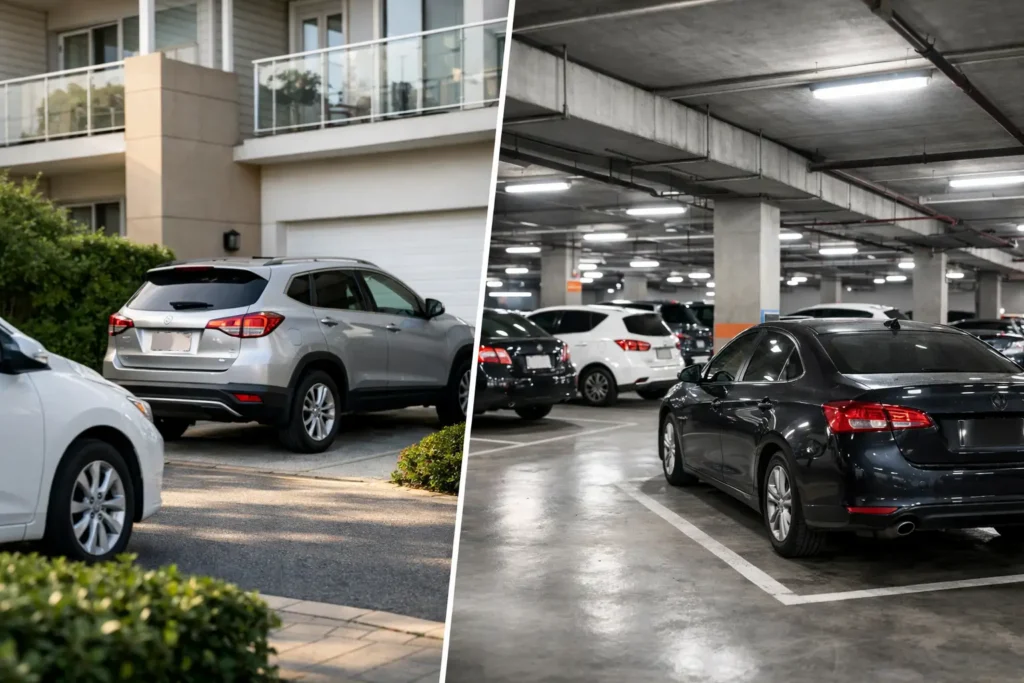
Residential Parking vs Public Car Park
If you need somewhere to leave a vehicle every day, the difference between residential parking vs public car park is not a small detail. It affects how secure your car feels at night, how easy your routine is each week, and whether the monthly cost actually makes sense over time. For many drivers in Manchester city centre and Salford, the better option depends less on headline price and more on how they use the space.
A resident in New Jackson who drives a prestige car has different priorities from a commuter working near Spinningfields. A landlord with an unused bay has different concerns again. That is why this comparison is worth looking at properly, not just in terms of cost, but access, reliability, building rules and day-to-day practicality.
Residential parking vs public car park: what is the real difference?
Residential parking usually means a privately owned or privately managed off-street bay, garage or allocated space linked to a flat development, gated scheme or residential block. In many cases it is used by one driver on a long-term basis, often monthly, with direct access arrangements agreed with the owner or managing party.
A public car park is designed for broader public use. It may serve shoppers, office workers or general city-centre demand. That model suits short visits and flexible use, but it is not always built around the needs of someone who wants dependable, long-term parking close to home or work.
That distinction matters. When parking becomes part of your weekly routine rather than an occasional need, predictability tends to matter more than flexibility. You are not just paying for a place to leave a vehicle. You are paying for confidence that the space will still work for you next month.
Security and control are usually where residential parking pulls ahead
For drivers storing a valuable vehicle, residential parking often feels more controlled. An allocated bay inside a managed development or a private garage tends to have fewer unknowns than a general-access setting. There may be gated entry, concierge oversight, fob access, CCTV or simply a lower volume of people moving through the site.
None of that guarantees perfection, and some residential spaces are better than others. A poorly lit bay in an open courtyard is not automatically superior because it is labelled residential. But when the space is inside a secure development in places such as Deansgate, Greengate or MediaCity, the level of control is often better suited to long-term use.
Public car parks can still be well run, but they are built for turnover. More users, more movement and less exclusivity can create a different security profile. If your vehicle is a practical daily runaround, that may be acceptable. If it is a performance car, classic car or high-value vehicle, many owners prefer a setting with fewer variables.
Convenience is not just about distance
Drivers often start by looking at postcode and walking time, which is sensible, but convenience goes further than that. A residential space can be more useful because access is straightforward and consistent. You know where the bay is, when it is available and what the entry process looks like. That matters on a wet Tuesday night just as much as it does on a Monday morning.
In contrast, some public facilities work well until they do not. Entry systems, changing availability and less personalised arrangements can make regular use feel more transactional. If you are parking every working day or leaving a vehicle for extended periods, that friction adds up.
For residents in large city-centre developments, having a nearby private bay can also remove a common problem: living in a premium building but still having no practical long-term parking attached to the flat. That gap is increasingly common in fast-growing areas where demand for residential spaces outstrips supply.
Cost comparisons can be misleading at first glance
On paper, a public car park can look simpler because the pricing is visible and standardised. But long-term users need to think beyond the obvious monthly figure. The better question is whether the arrangement gives enough value for the way the vehicle is used.
Residential parking often commands stronger monthly rates in high-demand developments because the supply is limited and the location is specific. A bay under a secure tower in the city centre is not interchangeable with a general car park space several streets away. The premium reflects convenience, security and scarcity.
That said, private residential parking can be better value over time because it is tailored to regular use. You are not paying for flexibility you do not need. You are paying for a fixed solution that supports your routine. For businesses arranging employee parking, or for residents who want a dependable setup close to home, that consistency can justify the monthly cost very quickly.
For parking space owners, the comparison matters too. An unused residential bay is often more valuable than expected because it solves a specific local problem. In the right development, a well-located allocated space can generate reliable monthly income from a carefully matched long-term driver.
Residential parking vs public car park for different types of driver
The right choice depends heavily on the driver.
If you live in a city-centre flat without an allocated bay, residential parking is often the more natural fit. It keeps the vehicle close to home and tends to offer a more settled arrangement. That is especially relevant in developments where on-site or nearby parking is limited.
If you commute into a fixed business district each week, either option can work, but the balance shifts according to routine. A driver who wants the same secure place each day may prefer a private residential bay near the workplace. Someone who values wider location choice may accept the trade-off of a more general setup.
If the vehicle is a prestige, performance or collectible model, the argument usually moves in favour of secure private parking. Owners in that category are rarely looking for the cheapest possible option. They are looking for fewer risks, better control and a space they would feel comfortable using for months, not just days.
For employers, private monthly parking can also be easier to manage than piecing together ad hoc arrangements. Staff benefit from a clear, dependable solution, and businesses avoid the uncertainty that comes with relying on availability that may change.
What parking space owners should consider
From the owner side, residential parking has a clear advantage: it can be monetised without changing the nature of the asset. If you own a bay, garage or allocated space that sits empty most of the time, there is often demand from residents, commuters and nearby businesses looking for long-term use.
The best arrangements are simple. Clear access terms, realistic monthly pricing and a suitable match matter more than trying to maximise every last pound. In premium developments, owners are often better served by finding one dependable long-term user than by treating the bay as a revolving door.
Owners should still be practical. Check lease terms, management rules and access restrictions. A space is only attractive if it can be used easily and lawfully. If the bay is awkward to reach, unsuitable for larger vehicles or limited by building conditions, that should be clear from the start.
When a public car park may still make sense
This is not a case of residential parking always winning. Some drivers do not need a fixed private setup. If your parking pattern changes regularly, or you are not concerned about keeping the vehicle near a specific building, a public car park may still suit you well enough.
The same applies if the vehicle is used occasionally and security requirements are modest. Paying a premium for a private residential space only makes sense if the benefits are relevant to your situation. If they are not, the extra cost may be unnecessary.
The key is to be honest about what you actually need. Many people start by chasing the lowest monthly figure and then realise the arrangement is inconvenient, too far away or not well suited to the vehicle. Others pay for features they barely use. The sensible option sits somewhere between those two mistakes.
The smarter long-term choice usually comes down to fit
In Manchester, where demand for secure off-street parking is high around major residential and business districts, long-term parking works best when it matches the building, the driver and the vehicle. That is why residential parking continues to appeal to flat residents, professionals, businesses and owners of valuable cars who want something more dependable than a general-access alternative.
Manchester City Parking focuses on that middle ground – matching drivers with long-term private bays, garages and secure residential spaces that make everyday parking simpler. For owners, it also turns underused spaces into a practical monthly asset without unnecessary complexity.
If your vehicle needs a proper long-term home rather than just a place to stop, the best decision is usually the one that removes uncertainty from your routine.