Parking Access Rights: What Renters Must Check
A parking bay can look perfect on a listing yet be of little practical use if the driver cannot reliably reach it. Parking access rights are the difference between having a marked space and having a space that can be used every day, without disputes with a concierge, management company, neighbour or landowner.
For long-term private parking in Manchester, this matters most in dense residential developments, converted buildings and mixed-use schemes. A bay may sit behind gates, beneath a podium, within a shared courtyard or in a basement with restricted entry. Before money changes hands, both the driver and the bay owner need clarity on who is entitled to enter, how entry works and whether the proposed rental is permitted.
What parking access rights actually mean
Parking access rights are the legal and practical permissions that allow a person to get a vehicle to and from a specific parking space. They can arise from a property lease, title documents, a tenancy agreement, a licence granted by a management company or an established right of way over shared land.
The key point is that ownership or use of a bay does not automatically give unrestricted access to every person the owner chooses. In many flat developments, the parking space is allocated to a particular flat, but the route into the car park is controlled by the freeholder or managing agent. Gates, fobs, shutters and internal roads are shared facilities governed by the building’s rules.
A driver renting a bay needs more than an assurance that the space exists. They need a workable right to enter the site, park there for the agreed term and leave when needed. The owner needs confidence that allowing another driver to use the bay does not breach their lease or create a problem with the building management.
This is especially relevant around Deansgate, New Jackson, Castlefield, Greengate and Salford Quays, where secure underground and gated parking can be closely managed. Access arrangements vary considerably between developments, even when the bays appear similar.
The difference between a parking space and a right to park
Property documents use different language, and the distinction can be significant. A flat may include a numbered bay within its title, have an exclusive right to use a bay, or simply benefit from a licence issued by the building manager. Each arrangement can carry different rules around renting the space to somebody else.
A demised parking space is generally part of the property interest granted to the flat owner under the lease. That does not mean there are no restrictions. The lease may still require consent before the bay is let separately, prohibit commercial use, or limit use to the flat’s occupier.
An allocated bay may instead be a right granted by the development rather than an asset owned outright. If it is tied to the flat, it may not be capable of being rented independently. In some buildings, only residents can hold an access fob or register a vehicle. In others, an external long-term renter is accepted once the correct details have been supplied.
A licence is often more limited again. It may be revocable, personal to the resident or subject to changing management policies. Space owners should not describe a bay as available for unrestricted rental until they understand which arrangement applies.
What a driver should confirm before agreeing a monthly rental
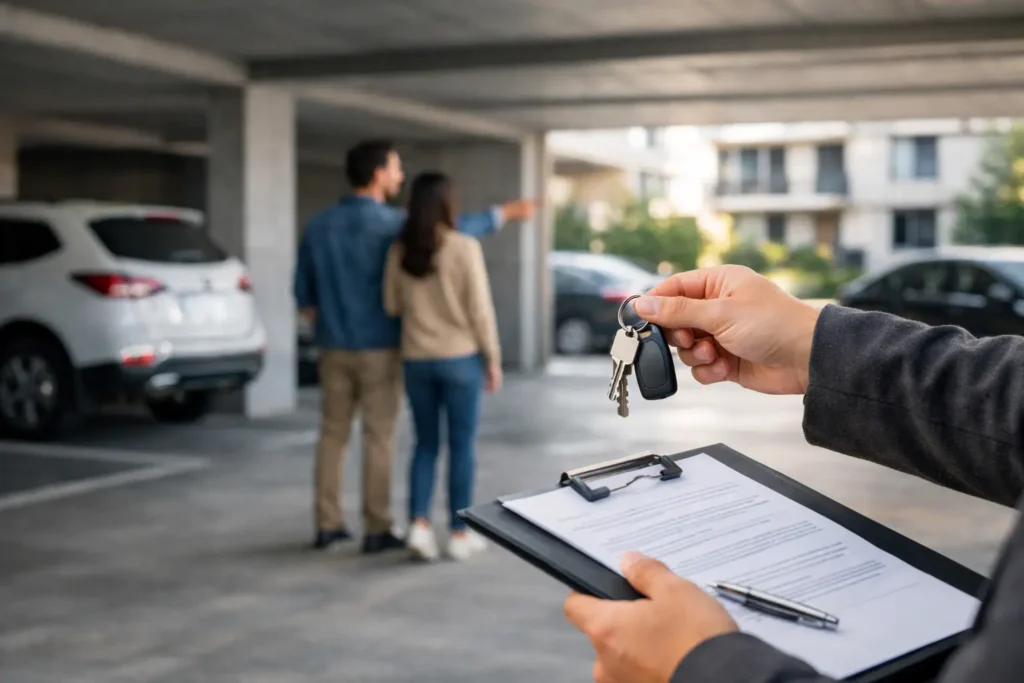
A sensible long-term arrangement starts with specific questions, not assumptions. The bay owner should be able to confirm the space number, location and ordinary access route. If the space is in a secure development, ask whether an access fob, remote, permit or vehicle registration is needed and who authorises it.
There are four practical points worth confirming in writing:
- The driver may access the car park for the agreed rental period, including outside typical concierge hours where relevant.
- The bay is not reserved for a named resident, visitor scheme or another user under the building rules.
- The vehicle fits the space, ramp, turning area and any height restriction at the entrance.
- The owner is permitted to rent the bay separately and can provide the required access device or arrange registration.
These checks are not about creating unnecessary paperwork. They prevent the common frustrations that arise when a driver arrives to find that a shutter will not open, a fob has been deactivated, or the management company has not been told about the arrangement.
For owners of prestige, classic or performance vehicles, access is also part of security. A secure bay is only dependable when the gate, garage entrance and route to the space can be used consistently. It is sensible to inspect the route in person before committing, particularly in older city-centre buildings where turning space and ramp gradients can be tighter than expected.
Access devices, permits and management approval
An access device is not always transferable simply because the bay is being rented. Some developments issue fobs to individual leaseholders and require the managing agent to approve any additional device. Others may charge a replacement deposit or require the driver’s name, vehicle registration and contact details for site records.
The arrangement should state who holds the fob or remote, what happens if it is lost, and whether the driver will need to return it at the end of the rental. If access is controlled by a concierge, establish whether the driver is on an approved list and whether that approval has an end date.
Management approval is not a formality to leave until later. Where it is required, it should be obtained before the rental begins. A bay owner who lets first and asks questions afterwards risks leaving the driver without the access they have paid for. Equally, drivers should be cautious if they are asked to use somebody else’s resident fob without the building being informed.
At Manchester City Parking, the practical focus is on matching long-term users with private bays that can genuinely be used, rather than treating a parking space as a simple pin on a map. Clear access arrangements make the rental more dependable for both parties.
When lease restrictions affect parking access rights
Leasehold terms can restrict separate parking rentals in several ways. A lease may prohibit subletting part of the property, require the freeholder’s consent, restrict parking to private domestic use or prevent access devices being passed to non-residents. A landlord’s mortgage conditions or insurance arrangements may also require consideration where a garage is involved.
That does not mean a parking rental is impossible. Many buildings permit it, particularly where the bay is separately identifiable and the management company has a straightforward registration process. It depends on the wording of the lease and the policy of the development.
Owners should read the parking, alienation, use and regulations clauses in their lease rather than relying on what another resident has done. Building policies can change, and an informal arrangement that went unchallenged previously is not proof that it is permitted.
If the documents are unclear, the right next step is to ask the managing agent or seek independent property advice. This is particularly worthwhile where the bay produces regular monthly income or where there is any possibility of a disagreement with neighbours or the freeholder.
Setting out a clear arrangement between owner and driver
A straightforward written agreement protects both sides. It should identify the precise bay, the monthly payment, start date, notice period and access method. It should also make clear that the driver may use only that bay and must follow the site’s reasonable rules, including any requirements around gates, shared areas and visitor access.
For the owner, the agreement should require the return of fobs, remotes and permits at the end of the term. For the driver, it should confirm what will happen if an access device stops working or the owner loses the ability to provide access. Neither party benefits from vague promises when the parking arrangement is intended to last months rather than days.
Photographs of the entrance, bay number and access device condition can be useful at the start. They are particularly helpful for garages and basement spaces where a replacement remote or fob may carry a cost. Keep communication practical and proportionate: the aim is to make access predictable, not to turn a simple bay rental into an administrative burden.
Why clarity matters in high-demand developments
In areas where secure off-street parking is scarce, people can feel pressure to agree quickly. That is understandable for residents without an allocated bay, professionals working near Spinningfields or Oxford Road, and businesses seeking dependable employee parking. But a fast arrangement still needs a basic access check.
The strongest long-term parking rentals are usually unremarkable after the first week. The driver knows where to enter, the gate opens, the vehicle fits, the bay is available and the owner receives the agreed payment. That reliability begins with confirming the access rights behind the space, not just the painted number on the ground.
Before committing to any private bay, make access the first question rather than the last. A clearly authorised space with dependable entry is worth far more than a convenient-looking bay that cannot be used with confidence.